Last Updated: September 18, 2026
📄 In This Review
Quick answer: Our top pick in 2026 is the Keep your current mouse and improve positioning — our #1 rated choice. See the full ranked comparison, alternatives and buying advice below.
The Short Answer
Yes—an ergonomic mouse is worth it if your current mouse causes wrist, forearm, or thumb discomfort, or if you spend several hours a day navigating a computer. The one condition is that you choose a shape you can use comfortably and give yourself time to adjust; an “ergonomic” label alone does not guarantee a better fit.
For occasional computer use, the benefit is less certain. A standard mouse can be perfectly comfortable when it fits your hand, your desk setup is sensible, and you are not clicking or dragging continuously. But for office work, design, spreadsheets, gaming, or any task involving four or more hours of daily mouse use, a well-designed ergonomic model can be a practical upgrade rather than a luxury.
As an Amazon Associate we earn from qualifying purchases at no extra cost to you.


What You Actually Get
See also: Standing Desk 50 Inch Height: Who Needs It and Why • Standing Desk Height for 5’10”: Your Target Number and How to Dial It In
Most ergonomic mice change the position of your hand, not the computer functions themselves. A conventional mouse encourages your palm to face down toward the desk. A vertical mouse rotates your hand so your thumb points upward and your palm sits in a more neutral, handshake-like position. Other designs use a sloped shell, a thumb rest, a trackball, or a wider body to reduce gripping.
The most common ergonomic mouse types include:
- Vertical mice: These are the most noticeable departure from a regular mouse. Many sit at an angle of roughly 50 to 70 degrees and include left- and right-click buttons on the side of the shell.
- Sloped mice: These provide a more gradual angle and are usually easier to learn, though the change in wrist position is less dramatic.
- Trackball mice: You move a ball with your thumb or fingers while the mouse stays in place. They can reduce large arm movements, especially on a small desk.
- Large or contoured mice: These provide a broader palm rest and thumb support without making you adopt a completely different grip.
The physical difference can be substantial. A typical compact mouse may be about 4.0 inches long, 2.3 inches wide, and 1.4 inches high, while a full-size vertical model may approach 4.5 to 5.0 inches long and 3.0 inches wide. Weight commonly ranges from about 2.5 ounces for a travel mouse to 5 ounces or more for a contoured wireless model. Bigger is not automatically better: a mouse that is too large can make your fingers stretch, while one that is too small may force a tight claw grip.
Wireless models generally use either a USB receiver or Bluetooth. Receiver-based mice are often simple to set up and work with more desktop computers, while Bluetooth saves a USB port but may be less convenient during operating-system setup or troubleshooting. Battery life can range from a few months on disposable batteries to several years on efficient office models. Rechargeable versions typically need charging every few weeks to several months, depending on use.
Pros
- A more neutral wrist position: Vertical and angled designs can reduce the amount of forearm rotation required to control a pointer. That may feel easier during long work sessions.
- Less reliance on a tight grip: A shaped shell, thumb rest, and palm support can help you guide the mouse with your whole hand instead of pinching it with your thumb and fingertips.
- Potentially better comfort over long days: The improvement is most noticeable for people who click, select, scroll, or move a pointer repeatedly for hours.
- Useful extra buttons: Many ergonomic mice include forward and back buttons, and some let you assign shortcuts for copy, paste, browser tabs, or productivity software.
- Good options at multiple prices: An entry-level vertical mouse such as the Anker 2.4G Wireless Ergonomic Mouse, listed around $19.98, can provide the basic shape without a major investment. A more refined option such as the Logitech Lift Vertical Ergonomic Wireless Mouse, listed around $64.49, adds a more polished build and broader software support.
- Can reduce mouse travel: A comfortable shape may let you keep the device closer to your keyboard, reducing repeated reaching across the desk.
Cons
- There is an adjustment period: Expect several days, and sometimes one to two weeks, to regain your usual pointing accuracy. Vertical buttons can initially feel backward or awkward.
- The shape may not suit everyone: People with small hands may struggle with a large vertical mouse. Left-handed users also have fewer choices, particularly in budget models.
- It will not fix a poor workstation: A mouse cannot compensate for a desk that is too high, unsupported forearms, a bent wrist, or nonstop work without breaks.
- Some designs are slower for precision tasks: The taller body and altered grip may feel less natural for detailed photo editing, competitive gaming, or other work requiring rapid, precise movements.
- Wireless compromises remain: You may need to replace batteries, recharge the mouse, store a USB receiver, or manage Bluetooth pairing. A receiver can also be easy to lose when traveling.
- More cost does not guarantee more comfort: Premium materials, quieter switches, and software controls are useful, but they do not replace proper hand size and shape matching.
Who Should Buy It
An ergonomic mouse is a strong candidate if you use a computer for at least four to six hours most weekdays, notice wrist or forearm fatigue, or frequently tense your hand while pointing and clicking. It is also worth considering if you already use an ergonomic keyboard, adjust your monitor and chair carefully, and want to improve one remaining contact point in your setup.
Choose a vertical model when your main goal is changing forearm rotation and you are willing to spend time learning a new grip. Choose a sloped or contoured model when you want a gentler transition from a traditional mouse. If you have limited desk space or tend to make broad mouse movements, a trackball may be more useful than either design.
Before buying, measure your hand from the wrist crease to the tip of your middle finger. As a rough starting point, a mouse around 4 inches long may suit smaller hands, while hands over approximately 7.5 inches may feel better with a larger shell. These are only guidelines, because finger length, grip style, and thumb placement matter just as much.
Who Should Skip It
Skip an ergonomic mouse if you use a computer for only short periods and feel comfortable with your current model. There is little reason to replace a mouse that already supports your hand, tracks reliably, and does not cause fatigue.
You may also want to skip a strongly vertical design if you need maximum precision immediately, switch between several computers, or share a mouse with people who prefer a conventional shape. A neutral-looking sloped mouse is easier for multiple users to adapt to. Left-handed buyers should check the product shape carefully; many inexpensive ergonomic mice are right-handed only.
Most importantly, do not use any mouse through worsening pain, numbness, or tingling. Change your setup, take breaks, and consider professional medical advice if symptoms persist. Comfort accessories are not medical treatment.
Cheaper Alternatives
| Option | Cost | Trade-off |
|---|---|---|
| Keep your current mouse and improve positioning | $0 | Place it beside the keyboard, keep your elbow near your side, and support your forearm. This costs nothing but cannot change the mouse’s basic shape. |
| Basic wired ergonomic mouse | $10–$20 | Usually the least expensive way to try a contoured or vertical grip, but cable management and simpler switches are common. |
| Anker 2.4G Wireless Ergonomic Mouse | About $19.98 | Affordable right-handed vertical design with a USB receiver; expect fewer premium controls and less flexibility than pricier models. |
| Used or sale-priced premium ergonomic mouse | $25–$50 | Can deliver a better shell and sensor for less, but battery condition, warranty coverage, and cosmetic wear vary. |
| Logitech Lift Vertical Ergonomic Wireless Mouse | About $64.49 | More expensive, but typically offers a refined vertical shape and useful software features; still not ideal if the size does not match your hand. |
A simple wired model is often the smartest low-risk test. If you like the grip but want quieter clicks, wireless convenience, or programmable buttons, you can move up later. Buying an expensive model first is unnecessary unless you already know which shape works for you.
FAQ
Does an ergonomic mouse really help wrist pain?
It can help reduce strain for some users by changing hand position and reducing gripping, but results vary. Pain can also come from posture, keyboard height, excessive workload, or an existing condition. Treat the mouse as one part of a broader setup, not a guaranteed solution.
How long does it take to get used to a vertical mouse?
Many people need several days to one or two weeks. Start with ordinary browsing and office tasks before using it for precision-heavy work. Adjust pointer speed gradually rather than making a dramatic change on the first day.
Is a wireless ergonomic mouse better than a wired one?
Not inherently. Wireless models reduce cable clutter and make it easier to position the mouse, while wired models avoid batteries, charging, and pairing. For a stationary desk, either can be comfortable. Choose based on convenience, connection needs, and price.
What should I look for when buying one in 2026?
Prioritize hand-size compatibility, a comfortable thumb rest, accessible buttons, a reliable scroll wheel, and a return policy. Check whether it is right- or left-handed, whether it uses Bluetooth or a USB receiver, and whether the battery is rechargeable or replaceable. A comfortable fit matters more than extra buttons, lighting, or a high maximum sensitivity rating.
Ready to decide? Our #1 pick for 2026 is the Keep your current mouse and improve positioning.
Live price & availability on Amazon.
Related Reviews & Guides



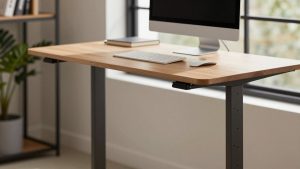
Standing Desk 50 Inch Height: Who Needs It and Why

Blue Light Blocking Glasses Computer