Last Updated: September 29, 2026
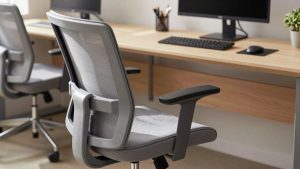
Lumbar support is the feature most people point to when they buy an ergonomic chair, and the one most people set wrong. A support that sits too high pushes the upper back forward; one that sits too low presses on the hips; one that pushes too hard makes you perch on the seat edge. This guide explains how to find the right position, how to adjust the common lumbar systems and how to tell when your settings are right.
📄 In This Review
Quick answer: Our top pick in 2026 is the Upper back pushed forward — our #1 rated choice. See the full ranked comparison, alternatives and buying advice below.
Why lumbar position matters
Your lower spine has a natural inward curve. When you sit without support, the pelvis tends to roll backward and the curve flattens, which loads the discs and muscles of the lower back. A well-placed lumbar support fills that curve so the spine stays close to its neutral shape without effort.
The goal is contact, not pressure. You should feel the support meeting your back evenly, not pushing you forward or creating a hard spot.
Step by step: finding the right height
See also: Best Roku Streaming Deals Reviewed • Olipop Flavors Ranked: Best Tastes from Worst to Best
1. Set seat height first
Adjust the seat so your feet rest flat and your thighs are roughly parallel to the floor. Lumbar height is measured relative to the seat, so changing seat height later throws it off.
2. Sit all the way back
Slide your hips to the back of the seat. If you perch forward, no lumbar support can reach you.
3. Locate your curve
Place a hand at your lower back. The deepest part of the curve is typically just above your belt line, often about 6 to 10 inches above the seat surface for average adults.
4. Move the support to meet it
Slide the lumbar pad or backrest until its firmest point sits in that curve. Sit upright and notice whether the contact feels even.
Lumbar adjustment troubleshooting
Match the symptom to the likely cause and fix.
| Symptom | Likely cause | Fix |
|---|---|---|
| Upper back pushed forward | Lumbar too high | Lower the support 1 to 2 inches |
| Pressure on the hips | Lumbar too low | Raise the support |
| Perching on seat edge | Too much depth or firmness | Reduce depth; sit back fully |
| No contact at all | Too little depth or too deep seat | Increase depth or add a cushion |
| Aching after 2 hours | Static posture | Take breaks; recheck height |
| Support drifts during day | Loose pad or strap | Tighten or use strap cushion |
Adjusting depth and firmness
Many chairs let you push the lumbar forward or tune its firmness with a knob. Start with the minimum depth and increase in small steps until you feel gentle support. If you notice yourself leaning forward to escape the pressure, reduce it.
Chairs with dynamic or self-adjusting lumbar need little tuning, but height still matters. On chairs with a fixed curve, the only adjustment may be moving the entire backrest up or down.
Adjusting common lumbar systems
Sliding pad
Grip the pad or handles at each side and slide it up or down. Some pads also have a depth knob or lever.
Backrest height
Some chairs move the whole backrest. Lift it until it clicks at the desired height; to lower, raise it to the top and let it drop to the bottom, then lift again.
Knob or dial
Turn clockwise for more support and counterclockwise for less. Adjust while seated so you can feel the change.
Integrated internal lumbar
Gaming-style chairs often have a side knob for depth and a slider for height hidden under the cover. Adjust while seated for accurate positioning.
When a chair’s lumbar does not fit
If your chair has no adjustable lumbar or its range misses your curve, a separate lumbar cushion can help. Choose one with a strap so it stays in place, and aim for a thickness of about 2 to 4 inches. Too thick a cushion pushes you forward and reduces effective seat depth.
FAQ
How high should lumbar support be on an office chair?
It should meet the deepest part of your lower-back curve, usually just above the belt line and roughly 6 to 10 inches above the seat for average adults.
Should lumbar support feel firm?
It should feel supportive but not pushy. You want even contact without being pushed forward.
Bottom line
Adjust lumbar support after setting seat height, sit all the way back, place the support at the deepest part of your lower-back curve and add depth only until you feel gentle contact. Recheck after a few days, and use a strapped cushion if your chair’s range cannot reach you.
Ready to decide? Our #1 pick for 2026 is the Upper back pushed forward.
Live price & availability on Amazon.
Related Reviews & Guides
Best monitor arm for iMac
Home office setup for real estate agents