Last Updated: September 29, 2026
Employees working from home can call IT when the laptop dies or the internet drops. Freelancers cannot. When you work for yourself, your home office is your entire business infrastructure: the equipment is your capital, downtime is lost income, and a missed deadline because of a failed drive can cost a client. A freelancer’s setup should therefore be judged not only by comfort but by resilience. The goal is a workspace that keeps earning even when something goes wrong.
📄 In This Review
Quick answer: Our top pick in 2026 is the Internet outage — our #1 rated choice. See the full ranked comparison, alternatives and buying advice below.
Think in terms of single points of failure
List every item your work cannot continue without: the computer, the internet connection, power, your files and your phone. For each one, ask what happens if it fails at 4 p.m. on a deadline day. The answers shape your priorities better than any shopping list.
| Failure | Backup plan | Approximate cost |
|---|---|---|
| Internet outage | Phone hotspot with enough data, or a secondary connection | $0–$50 per month |
| Power cut | UPS for router and computer; laptop battery | $80–$250 |
| Drive failure or theft | Automatic cloud backup plus a local external backup | $60–$150 per year plus $60–$120 drive |
| Computer failure | Older laptop or tablet kept updated as a spare | Often already owned |
| Lost accounts access | Password manager and recovery codes stored safely | $0–$40 per year |
Backups: the non-negotiable
See also: Best Roku Streaming Deals Reviewed • Olipop Flavors Ranked: Best Tastes from Worst to Best
The widely used 3-2-1 approach is a sensible baseline: keep three copies of important data, on two different types of storage, with one copy offsite. For most freelancers that means working files synced to a cloud service, an automatic full-system backup to an external drive, and a separate cloud backup service or archive. Test a restore occasionally; a backup you have never restored is only a hope.
Connectivity and power
Plug the computer into the router with Ethernet if you can, especially for video calls with clients. Put the router and modem on a small UPS so a brief power flicker does not drop your connection. Know your phone plan’s hotspot allowance and test it before you need it.
Separate business from home
A dedicated space
Even a small dedicated corner creates a boundary between client work and home life, which matters when there is no office to leave. In some tax systems, a space used regularly and exclusively for business may qualify for a home office deduction; rules vary widely by country and situation, so check with a qualified accountant before claiming anything.
Separate accounts and devices where practical
A separate business phone number, via a second SIM, eSIM or a calling app, lets you switch off client contact in the evening. A separate user account on your computer for personal use keeps client files and personal browsing apart.
Equipment as investment
Freelancers tend to under-invest because every purchase feels like a cost. Consider how many hours an item affects. A $400 chair used 1,500 hours a year costs about 27 cents an hour in its first year and less every year after. A second monitor that saves ten minutes a day pays for itself quickly at most freelance rates. Buy tools that remove daily friction first, and keep receipts for your accountant.
Presenting professionally
Clients judge you partly by how you appear on calls. A clean background, a decent webcam, a soft key light and a headset or external microphone all signal competence. None of these need to be expensive; a $60 webcam, a $50 light and a $70 headset make a large difference compared with a laptop camera in a dim room.
Admin station
Freelancers handle invoices, contracts and receipts. A document scanner or a good phone scanning app, a small filing system and a notebook for call notes save time at tax season. Consider a second screen dedicated to email and project management while the main screen holds the work itself.
FAQ
What should a new freelancer buy first?
A reliable backup system and a comfortable chair. Backups protect your income; the chair protects your body during long hours.
Is a UPS worth it for a home office?
For freelancers, yes. Even a small unit that keeps the router and computer running for 10–20 minutes lets you save work and finish a call during an outage.
Bottom line
A freelancer’s home office is business infrastructure. Plan for failures first with backups, a UPS and a connectivity fallback, then separate business from home, invest in tools that save daily time, and present professionally on calls. Resilience is the feature clients never see but always benefit from.
Ready to decide? Our #1 pick for 2026 is the Internet outage.
Live price & availability on Amazon.
Related Reviews & Guides
Best desk footrest for under a standing desk
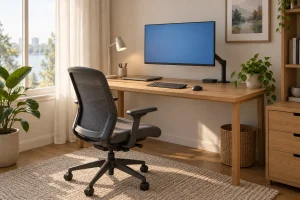
Home office setup for small bedroom