Last Updated: September 18, 2026
📄 In This Review
The Short Answer
For most people with small hands, the best ergonomic mouse size is approximately 4.0 to 4.5 inches long (10.2 to 11.4 cm), 2.4 to 2.9 inches wide (6.1 to 7.4 cm), and 1.4 to 1.7 inches tall (3.6 to 4.3 cm). Look for a mouse that lets your fingers reach the buttons without stretching and keeps your palm lightly supported rather than pressed flat.
Measure your hand from the wrist crease to the tip of your middle finger. If that length is under 6.7 inches (17 cm), start with a small or small/medium mouse. A compact ergonomic mouse is usually a better match than a full-size vertical model, although grip style matters just as much as hand length. Fingertip and claw grips generally need less mouse length than a relaxed palm grip.
As an Amazon Associate we earn from qualifying purchases at no extra cost to you.


Among common options, compact wireless models may cost about $18 to $35, while premium ergonomic designs typically range from $50 to $80 or more. For 2026, shoppers should also compare the mouse’s overall dimensions, button reach, tracking surface, and connection type instead of relying only on labels such as “small” or “ergonomic.”
Standard Sizes
See also: Standing Desk 50 Inch Height: Who Needs It and Why • Standing Desk Height for 5’10”: Your Target Number and How to Dial It In
Mouse sizing is not governed by one universal industry standard. The categories below are practical buying ranges based on external mouse dimensions, not internal components or packaging. Width includes the widest point, and height includes the highest point of the shell.
| Mouse size | Typical length | Typical width | Typical height | Best hand length | Typical weight |
|---|---|---|---|---|---|
| Compact | 3.7–4.1 in (9.4–10.4 cm) | 2.1–2.5 in (5.3–6.4 cm) | 1.3–1.6 in (3.3–4.1 cm) | Under 6.3 in (16 cm) | 2.1–3.2 oz (60–90 g) |
| Small | 4.0–4.4 in (10.2–11.2 cm) | 2.3–2.8 in (5.8–7.1 cm) | 1.4–1.7 in (3.6–4.3 cm) | 6.3–6.9 in (16–17.5 cm) | 2.5–3.9 oz (70–110 g) |
| Medium | 4.3–4.8 in (10.9–12.2 cm) | 2.6–3.0 in (6.6–7.6 cm) | 1.5–1.9 in (3.8–4.8 cm) | 6.9–7.7 in (17.5–19.5 cm) | 3.2–4.6 oz (90–130 g) |
| Large | 4.7–5.2 in (11.9–13.2 cm) | 2.9–3.4 in (7.4–8.6 cm) | 1.7–2.1 in (4.3–5.3 cm) | Over 7.7 in (19.5 cm) | 4.2–5.6 oz (120–160 g) |
A vertical mouse may have a similar length and width but a noticeably greater height because your hand rests at an angle. A 57-degree vertical design, for example, can feel larger than a conventional mouse with the same listed length. Check the side profile and thumb-rest shape before ordering.
How to Measure Your Space
- Measure your hand. Place your hand flat with your fingers together. Measure from the wrist crease to the tip of the middle finger. Record the result in inches or centimeters.
- Measure your palm width. Measure across the widest part of your palm, excluding the thumb. A mouse that is much narrower than your palm may feel unstable, while one that is substantially wider can force your wrist outward.
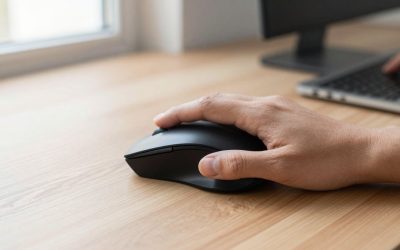
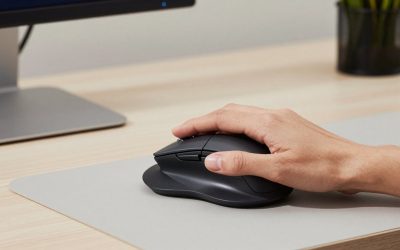
- Compare the mouse length. For a palm grip, choose a mouse roughly 0.5 to 1.2 inches (1.3 to 3 cm) shorter than your hand. Your palm should be supported without your fingertips touching the front edge.
- Check button reach. With your hand resting naturally, your index and middle fingers should sit over the primary buttons. You should not need to slide your hand forward to click or curl your fingers sharply backward.
- Measure desk clearance. Leave at least 2 inches (5 cm) of free space on the mouse’s active side. For low-sensitivity settings or wide monitor setups, 8 to 12 inches (20 to 30.5 cm) of side-to-side travel is more comfortable.
- Check keyboard spacing. If your mouse sits beside a full-size keyboard, measure the gap between the keyboard and the desk edge. A narrow mouse, around 2.3 to 2.6 inches (5.8 to 6.6 cm) wide, can prevent your shoulder from being pushed outward.
- Account for accessories. A charging cable, wrist rest, desk edge, or laptop stand can reduce usable space. Measure the area where the mouse will actually move, not the entire desktop.
By Room or Use Case
Home Office
For everyday writing, browsing, spreadsheets, and video calls, prioritize a small shell with a supportive thumb area and quiet or low-noise switches. A length of 4.0 to 4.4 inches (10.2 to 11.2 cm) is a useful starting range for small hands. Wireless models reduce cable clutter, but confirm whether the receiver needs a USB-A port or whether the mouse supports Bluetooth.
Basic ergonomic wireless mice often cost $18 to $35. Examples in this general value category include the Luhaso 57-degree vertical model, listed at $22.99, and the PHILIPS SPK7628, listed at $19.99. Treat brand size labels as a starting point and verify the actual dimensions before buying.
Small Desk or Shared Workspace
When the mouse must fit between a keyboard, notebook, and desk edge, width becomes especially important. Choose a model no wider than about 2.7 inches (6.9 cm) if your workspace is tight. A compact mouse weighing 2.5 to 3.5 ounces (70 to 100 g) is also easier to reposition repeatedly.
Keep at least 5 cm of movement space beside the keyboard. If you use a vertical mouse, allow extra clearance for the taller thumb rest and angled wrist position. A mouse can fit its footprint but still feel cramped when your hand needs room to rotate.
Long Workdays
For extended computer use, fit and neutral wrist posture matter more than the lowest price or highest DPI rating. A small vertical mouse can reduce the amount of forearm rotation for some users, but it should not force your elbow away from your body. The thumb and little finger should be supported without gripping the shell tightly.
Models in this category commonly range from $20 to $75. The TECKNET ergonomic wireless vertical mouse is a value-priced example listed at $17.99, while the Logitech Lift Vertical Ergonomic Wireless Mouse is a premium example listed at $69.25. Features such as adjustable DPI, silent clicking, and extra buttons may be useful, but they do not correct a poor size match.
Travel and Laptop Use
For a laptop bag, select a compact mouse between 3.7 and 4.2 inches (9.4 to 10.7 cm) long and under 3.5 ounces (100 g). A flat conventional design generally packs more easily than a tall vertical mouse. Bluetooth can eliminate the need to carry a receiver, although battery life and device compatibility should be checked.
Common Sizing Mistakes
- Choosing by hand length alone: Two people with the same hand length may have different palm widths, finger lengths, or grip styles.
- Assuming “ergonomic” means small: Many ergonomic mice are built for medium or large hands. Always compare length, width, and height.
- Ignoring height: A tall vertical mouse may create pressure under the palm or thumb even when its length is appropriate.
- Buying the lightest model automatically: Low weight can help with frequent repositioning, but an ultra-light mouse may feel less stable during precise work.
- Using a wrist rest as a sizing fix: A wrist rest cannot make an oversized mouse easier to reach. It may also raise the wrist too high if the mouse already has a tall shell.
- Confusing high DPI with better control: DPI changes pointer sensitivity, not physical fit. A comfortable size and a suitable tracking surface matter first.
- Forgetting the desk layout: A correctly sized mouse still feels awkward if the keyboard, chair, or desk edge forces your arm into an outward angle.
FAQ
What is the best ergonomic mouse size for small hands?
Start with a mouse about 4.0 to 4.4 inches long (10.2 to 11.2 cm), 2.3 to 2.8 inches wide (5.8 to 7.1 cm), and 1.4 to 1.7 inches tall (3.6 to 4.3 cm). Adjust down for fingertip grip or up slightly for a relaxed palm grip.
Are vertical mice good for small hands?
They can be, provided the thumb rest and buttons are within easy reach. Choose a compact vertical model rather than assuming a standard medium-size design will fit. Your fingers should rest on the buttons without stretching, and your wrist should remain relaxed rather than tilted toward the little-finger side.
How wide should a mouse be for a small hand?
A width of about 2.3 to 2.8 inches (5.8 to 7.1 cm) suits many small hands. If your palm is narrow, stay near the lower end. If the mouse feels difficult to stabilize, a slightly wider thumb shelf may be more comfortable than an extremely narrow shell.
Does mouse weight matter for small hands?
Yes. A mouse weighing roughly 2.5 to 3.9 ounces (70 to 110 g) is a practical range for many small-hand users. Lighter models require less effort to move, while a moderately heavier model can feel steadier for detailed work. Fit, glide, and desk space should guide the final choice.
Ready to decide? Our #1 pick for 2026 is the Compact.
Live price & availability on Amazon.
Related Reviews & Guides


Quick Picks: Best Whiteboard Wall Panels for Home Office
3 Best Compact Keyboards for Small Desk Setups