Last Updated: September 26, 2026
Virtual backgrounds look effortless in marketing screenshots and messy in real meetings: hair that dissolves into the fake bookshelf, a hand that vanishes when you gesture, a halo that shimmers around your shoulders every time you lean back. Most of that is not the fault of Zoom or Teams. Segmentation software can only cut you out cleanly when the camera feeds it a sharp, well-exposed, low-noise image with clear separation between you and the wall behind you. This guide explains which webcam traits actually improve background replacement, which ones are marketing noise, and how to set up the room so even a mid-range camera produces a clean edge.
📄 In This Review
Quick answer: For most people in 2026, the best webcam for virtual backgrounds is the Sensor size — our #1 rated choice. See the full ranked comparison, alternatives and buying advice below.
Why virtual backgrounds break down
Background replacement works frame by frame. An AI model estimates which pixels belong to a person and which belong to the room, then paints the replacement image behind the mask. It struggles in three predictable situations: when the image is noisy (grain looks like texture that could be either hair or wall), when edges are soft because the camera is slightly out of focus, and when your clothing or hair colour is close to the colour of the wall. A better camera helps with the first two. Only you can fix the third.

OBSBOT Tiny 3 AI-Powered Spatial Audio 4K PTZ Webcam, Bundle with 3-in-1 USB 3.0 Hub Tri-Mic AI Tracking 2.0 Voice Control Gesture Control 1/1.28" Sensor 4K Streaming Camera
Included for 'Best webcam for virtual backgrounds' as a relevant option in this category; details come from the product listing.
View on AmazonNoise is the biggest enemy
In a dim home office a small-sensor webcam raises gain to stay bright, and gain means grain. The segmentation model sees speckle around your outline and hedges its bets, which produces the familiar flicker at the edges. A larger sensor, or simply more light on your face, lowers the gain and gives the model a cleaner boundary to work with.
Focus and frame rate matter more than resolution
A crisp 1080p image with reliable autofocus beats a soft 4K image every time. Frame rate matters too: at 30fps a fast hand movement smears across a frame, and the mask cannot keep up. Cameras that can hold 1080p at 60fps in good light produce noticeably steadier edges during gestures.
Webcam features that help, ranked
See also: Best Roku Streaming Deals Reviewed • Olipop Flavors Ranked: Best Tastes from Worst to Best
| Feature | Effect on background replacement | What to look for |
|---|---|---|
| Sensor size | High: less noise, cleaner edges in dim rooms | 1/2.8″ is typical of budget models; around 1/2″ or larger is a clear step up |
| Autofocus type | High: sharp outline around hair and shoulders | Phase-detection (PDAF) locks faster than contrast-detect |
| 1080p60 support | Medium: steadier mask during gestures | Check that 60fps is available at 1080p, not only 720p |
| HDR / exposure control | Medium: stops a bright window from darkening your face | Manual exposure lock in the vendor app |
| Built-in “AI background” in firmware | Low to medium: convenient, but meeting apps often do it as well | Useful mainly for apps without their own background tools |
| 4K resolution | Low for calls: most platforms send 720p-1080p | Useful only if you crop or record locally |
Camera classes worth considering
Mainstream 1080p webcams
Standard 1080p30 webcams in the $50-$90 range do fine for virtual backgrounds if the room is bright. They are the weakest in winter evenings, when gain rises and edges begin to crawl. If you buy one, budget for a small key light at the same time; the combination beats a pricier camera used in the dark.
Large-sensor 4K webcams
Cameras such as the Insta360 Link 2 and OBSBOT Tiny 2 Lite use roughly 1/2-inch sensors with phase-detection autofocus and support 1080p at 60fps. In practice that combination produces the cleanest hair edges we see from USB webcams at typical desk distances. Expect to pay roughly $150-$250; check each maker’s current spec sheet, since both brands refresh their lines often.
Mirrorless or phone as webcam
A mirrorless camera with a clean HDMI output, or a recent phone used as a webcam, has far larger sensors and real optical background blur. That natural depth of field can make a virtual background almost unnecessary. The cost is complexity: capture cards, power, mounts, and more setup each morning.
Set up the room for a clean cut-out
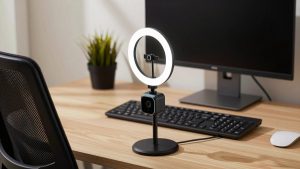
- Light your face, not the wall. Aim for your face to be noticeably brighter than the background. A soft light at 45 degrees and slightly above eye level is enough.
- Create distance. Sit at least 3-4 feet (about 1-1.2 m) in front of the wall if you can. Separation reduces shadows that confuse the mask.
- Use a plain, contrasting backdrop. A single-colour wall that differs from your hair and shirt helps more than any camera upgrade. A collapsible green screen behind the chair gives the best edge of all.
- Lock exposure. If the vendor app allows it, lock exposure and white balance so the image does not pulse when the background image changes brightness.
- Avoid busy patterns. Fine stripes and checks shimmer on compressed video and can be misread as background.
FAQ
Do I need a 4K webcam for virtual backgrounds?
No. What helps is the larger sensor and faster autofocus that tend to come with premium 4K models, not the 4K resolution itself. A well-lit 1080p camera with good autofocus will produce edges just as clean in a standard Zoom or Teams call.
Is a green screen still worth using?
Yes, if you present often or wear clothing close to your wall colour. Chroma keying is simpler than AI segmentation and gives a stable edge even with a modest camera. Keep the screen evenly lit and a couple of feet behind you to avoid green spill on your shoulders.
Bottom line
For virtual backgrounds, pick a webcam for its sensor size, autofocus and 1080p60 capability rather than its headline resolution, then put light on your face and space between you and the wall. A mid-range camera in a well-lit room beats a flagship in a dark one. If you want the cleanest result without a green screen, a large-sensor PDAF webcam is the upgrade that makes the most visible difference.
Ready to decide? Our #1 pick for 2026 is the Sensor size.
Live price & availability on Amazon.