Last Updated: September 29, 2026
If you wear glasses, you already know the video-call problem: a white rectangle of reflected monitor glare over each lens, or twin ring-light circles where your eyes should be. It is less a webcam problem than a geometry problem, because light bouncing off your lenses into the camera. Some webcam features make it easier to manage, and the right setup can remove glare almost entirely. This guide covers both.
📄 In This Review
Quick answer: For most people in 2026, the best webcam for glasses wearers is the Razer Kiyo Pro — our #1 rated choice. See the full ranked comparison, alternatives and buying advice below.
Why glasses reflect on camera
A reflection appears when a light source sits at the mirror angle to the camera across your lens. Your monitor, directly in front of you, is the most common culprit; a ring light mounted around the lens is the worst, because it sits exactly on the camera’s axis. The fix is to move light sources so their reflections bounce away from the lens, or to reduce their brightness relative to the rest of the scene.
Webcam features that help
See also: Best Roku Streaming Deals Reviewed • Olipop Flavors Ranked: Best Tastes from Worst to Best
Good dynamic range
If the camera can expose for your face while the screen glare stays controlled, reflections look less intense. HDR modes on webcams such as the Logitech Brio and the Razer Kiyo Pro help here.
Low-light performance
A camera that looks good in modest light lets you dim your monitor and move your lights to the side without the image going grainy. Larger-sensor webcams, including the Razer Kiyo Pro, Insta360 Link and Opal Tadpole, allow that.
Manual exposure
Locking exposure stops the camera brightening your face and the glare together. Most maker apps, such as Logi Tune, Razer Synapse and Insta360 Link Controller, offer this.
No built-in ring light
On-axis rings, like the one on the original Razer Kiyo, produce circular reflections on glasses. If you wear glasses, prefer a webcam without one and light from the side.
Webcams that suit glasses wearers
| Webcam | Why it helps | Typical price tier |
|---|---|---|
| Razer Kiyo Pro | STARVIS sensor, HDR at 30fps, lets you dim lights | $100-$200 |
| Logitech Brio (4K) | HDR, manual exposure in Logitech software | $130-$200 |
| Insta360 Link | 1/2-inch sensor, flexible tilt to change reflection angle | $200-$300 |
| Opal Tadpole | 1/2-inch sensor, compact, easy to reposition | $130-$175 |
| Anker PowerConf C200 | Budget option with low-light correction | $50-$60 |
Setup fixes that remove glare
Move your lights up and to the side
Place your key light at 30-45 degrees to one side and slightly above eye level. Reflections then bounce off at an angle away from the camera. A light bar or panel above the monitor, aimed down, also works.
Raise the camera slightly
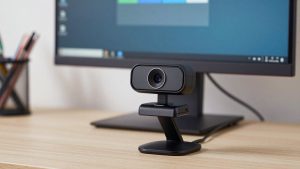
Mounting the webcam a few centimetres above eye level, looking slightly down, changes the reflection angle so that monitor glare bounces below the lens.
Tilt your glasses
Lowering the arms of your glasses a few millimetres above your ears tilts the lenses downward and moves reflections out of frame. Many presenters do this subtly.
Dim the monitor or use dark mode
A monitor at 100% brightness is a large light panel. Dropping to 40-60% and using dark mode during calls shrinks the reflection dramatically.
Anti-reflective coating
Lenses with a good anti-reflective coating cut reflections noticeably. It is worth adding at your next prescription if you are on video daily. Blue-light coatings can create a bluish or green sheen on camera.
A quick glare test before calls
Open your camera app and slowly turn your head left and right while watching your lenses. Note where reflections appear, then move the brightest light source a little further to the side or higher until they vanish in your normal sitting position. Repeat after changing monitor brightness. Five minutes of testing usually finds a glare-free arrangement you can keep permanently.
FAQ
Is a ring light bad for glasses wearers?
An on-axis ring light causes distinctive circular reflections. A ring moved to one side and above eye level works fine, but a softbox or LED panel at 45 degrees is easier to manage.
Do any webcams remove glasses glare with software?
Some AI effects in Windows Studio Effects, NVIDIA Broadcast and camera apps adjust eye contact or brightness, but they do not reliably remove reflections. Physical light placement remains the effective fix.
Bottom line
No webcam removes glasses glare on its own, but a camera with good HDR and low-light performance, such as the Razer Kiyo Pro, Logitech Brio or Insta360 Link, lets you move lights to the side and dim your screen without losing image quality. Combine that with a slightly raised camera and an anti-reflective lens, and glare disappears.
Ready to decide? Our #1 pick for 2026 is the Razer Kiyo Pro.
Live price & availability on Amazon.