Last Updated: September 26, 2026
A power strip on the floor is the root of most messy desks. Every device cable has to drop all the way down to it, the strip collects dust and pet hair, and the vacuum cleaner eventually yanks something loose. Lifting the strip off the floor and fixing it to the underside of the desk shortens every cable run and hides the tangle in one stroke. The question is how to mount it, because the right method depends on your desktop material, the strip’s design and how much weight is hanging from it.
📄 In This Review
Quick answer: For most people in 2026, the best under is the Keyhole screws — our #1 rated choice. See the full ranked comparison, alternatives and buying advice below.
Four ways to mount a power strip under a desk
Keyhole screws
Many surge protectors have two keyhole slots moulded into the back. Two short wood screws, spaced to match, let the strip hang directly under the desktop. This is the cleanest and cheapest method, but the slots only hold if the screws are driven to the right depth: too shallow and the strip falls off when you pull a plug, too deep and it will not slide on. Measure slot spacing with a ruler rather than trusting the packaging.

360° Mountable Surge Protector Power Strip with 4 USB Ports (2 USB C), 6 FT Electrical Outlet & Flat Plug Extension Cord for Under Desk, Wall, or Corner Mount (White)
Included for 'Best under-desk power strip mount' because the listing specifies Wall and or Corner Mount (White), details this guide uses to compare options.
View on Amazon
VILONG Dual Layer Desk Clamp Power Strip, 20W USB-C, 700J Surge Protector
Included for 'Best under-desk power strip mount' because the listing specifies 20W USB-C and 700J Surge Protector, details this guide uses to compare options.
View on Amazon
HOPOW Dual Layer Desk Clamp Power Strip, 13 Outlets 4 USB, 10FT Cord, Black
Included for 'Best under-desk power strip mount' because the listing specifies 13 Outlets 4 USB and 10FT Cord, details this guide uses to compare options.
View on Amazon
Under Desk Power Strip with 20W USB C, QBA 8-in-1 Desk Outlet Station, 4 AC Outlets, 2 USB-C, 2 USB-A, 6FT Cable, Desk Mount Power Strip for Home Office Conference, ETL Listed(Black)
Included for 'Best under-desk power strip mount' because the listing specifies QBA 8-in-1 Desk Outlet Station and 4 AC Outlets, details this guide uses to compare options.
View on AmazonDedicated mounting brackets
Universal power strip brackets are small steel or plastic cradles that screw to the desk and hold the strip with a strap or spring clip. They suit strips without keyholes and make removal easy, which matters if you rearrange equipment often. Expect to pay $10–$25 for a pair.
Adhesive mounts
Heavy-duty adhesive pads, including hook-and-loop strips like 3M Dual Lock, avoid drilling entirely. They are ideal for rented furniture and glass or metal tops. Their weakness is the pulling force when you unplug a stiff charger; adhesive bonds fail in peel far sooner than in shear. Reserve adhesive for lightweight strips and add a cable tie loop as a backup.
Clamp-on socket units
Some power units clamp onto the desk edge or rear rail instead of mounting underneath. They keep sockets reachable, which is useful if you plug in a laptop charger or phone every day. They are pricier, typically $30–$80, and the clamp needs a flat edge free of the desk frame.
Comparing the mounting methods
See also: Best Roku Streaming Deals Reviewed • Olipop Flavors Ranked: Best Tastes from Worst to Best
| Method | Cost | Drilling | Holding strength | Best for |
|---|---|---|---|---|
| Keyhole screws | Under $5 | Yes, two pilot holes | High if set correctly | Owned wood or particleboard desks |
| Mounting bracket | $10–$25 | Yes | High | Strips without keyholes |
| Adhesive or Dual Lock | $8–$20 | No | Moderate | Rentals, glass, metal, light strips |
| Clamp-on unit | $30–$80 | No | High | Frequently used sockets |
| Inside a cable tray | $20–$60 | Usually | High | Strips plus power bricks |
Choosing the strip itself
If you are mounting a strip anyway, choose one designed for it. Sockets spaced far enough apart for chunky adapters, or rotated 90 degrees, stop bricks from blocking neighbours. A flat plug on a 1.5–3 m cord makes the run to the wall neater. Look for a surge rating with a joule figure listed; for office electronics, 1,000 joules or more is a reasonable floor. Built-in USB-C ports are convenient, but check the per-port wattage if you intend to charge a laptop from it; many strips share a low total across all ports.
Safety details people skip
Do not daisy-chain a mounted strip into another strip; plug it directly into a wall socket. Leave some air around it rather than wrapping it in foam or packing it tight against a hot laptop brick. If your desk has a cable tray, you can mount the strip inside it, which spreads the weight and gives you a second restraint. And never mount a strip where liquids can drip onto it; the rear underside of the desk is better than the front edge where drinks sit.
Standing desk considerations
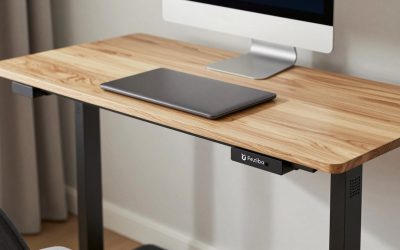
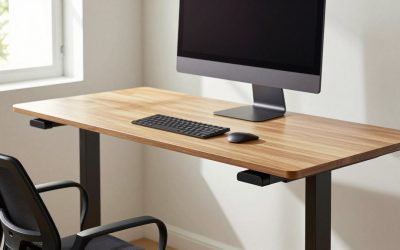
On a sit-stand desk, mount the strip to the desktop, not the frame’s base or the wall. That way every device cable rides up and down with the desk and only the strip’s own cord needs slack. Keep the strip clear of the motor housing and control box so nothing rubs during travel.
Step-by-step: keyhole mounting done right
Hold the strip where you want it and mark both keyholes with a pencil through the slots. Drill pilot holes about 2 mm across, no deeper than two-thirds of the desktop thickness. Drive pan-head screws until about 3 mm of the head stands proud, test-fit the strip, then adjust a quarter turn at a time until it slides on snugly and locks when pushed forward.
FAQ
How long should the screws be?
On an 18–25 mm thick desktop, screws of around 12–16 mm are usually safe. Always check the top’s thickness first, because a screw tip poking through the desk surface is an unfixable mistake.
Can I mount a power strip upside down?
Yes, most strips work in any orientation, and mounting sockets facing down actually helps keep dust out. Just make sure heavy plugs are fully seated so gravity does not work them loose.
Bottom line
Keyhole screws are the best mount for most owned desks; brackets fix strips without keyholes; adhesive is a rental-friendly compromise; clamp-on units suit sockets you touch daily. Whatever you choose, pick a well-spaced surge protector and mount it to the desktop so cables stay short.
Ready to decide? Our #1 pick for 2026 is the Keyhole screws.
Live price & availability on Amazon.
Related Reviews & Guides

Home office setup for video editors
Best monitor arm under 100 dollars