Last Updated: November 23, 2026
Front towers define a multichannel system’s scale and how hard your receiver works, while center and surrounds swap easily. Dual-woofer towers share the low-frequency load soundtracks place on the front pair, keeping bass and lower midrange composed at surround volumes. Our top pick: Klipsch RP-8000F Reference Premiere Floorstanding Speaker – Each (Ebony). Runner-up: Polk Signature Elite ES55 Tower Speaker – Hi-Res Audio Certified, Dolby Atmos & DTS:X Compatible, 1″ Tweeter & (2) 6.5″ Woofers, Polk Power Port Technology for Effortless Bass, Stunning Black.
This guide is for home theater builders assembling or upgrading a 5.1, 7.1, or Atmos-capable system around an AV receiver. The 4 speakers below were chosen from the names and specifications on their Amazon product pages, with priority given to dual woofer size, sensitivity, power handling, and impedance.
📄 In This Review
Quick Picks
As an Amazon Associate we earn from qualifying purchases.
| Product | Best for | Key spec from title |
|---|---|---|
| Klipsch RP-8000F Reference Premiere Floorstanding Speaker – Each (Ebony) | Large rooms and high playback levels | Dual 8″ copper-spun Cerametallic woofers |
| Polk Signature Elite ES55 Tower Speaker – Hi-Res Audio Certified, Dolby Atmos & DTS:X Compatible, 1″ Tweeter & (2) 6.5″ Woofers, Polk Power Port Technology for Effortless Bass, Stunning Black | Balanced front pair for mixed movie and music systems | (2) 6.5″ woofers with Power Port |
| Klipsch Reference Next-Generation R-600F Horn-Loaded Floorstanding Speaker for Best-in-Class Home Theater | Efficient front channels for modest receivers | Dual 6.5″ spun-copper TCP woofers, 96 dB sensitivity |
| SVS Prime Tower Sound Revolution Horn, Gloss Piano (1 per) | Listeners who want a dedicated midrange driver | Dual 6.5″ woofers, 4.5″ midrange, 3.5-way design |
How to Choose
See also: 3 Best Interior Locker Office Safes for Facility Management Offices (November 2026) • 3 Best Rolling Stand Blood Pressure Monitors for Staffed Measurement Stations (November 2026)
Woofer Size and What It Means for the Front Channels
Dual 6.5-inch woofers are common here — the Polk ES55, Klipsch R-600F, and SVS Prime Tower use them — while the RP-8000F steps up to dual 8-inch Cerametallic woofers. Larger woofers move more air in bigger rooms. You will still run a subwoofer, so treat woofer size as headroom where fronts and sub blend.
Sensitivity and Receiver Load
Sensitivity decides how loud a speaker plays with receiver power. The R-600F rates 96 dB sensitivity with 100 watts continuous and 400 watts peak handling, forgiving of entry-level receivers feeding five or more channels. The RP-8000F lists 150 watts maximum output power and 8-ohm impedance. Check your receiver’s impedance specification, especially with all channels driven.
Tweeter and Horn Design for Dialogue Clarity
Front towers carry music, effects, and dialogue edges beyond the center channel. Klipsch uses a 1-inch titanium LTS tweeter in a 90 x 90-degree Tractrix horn on the RP-8000F, and a 1-inch aluminum LTS tweeter with the same horn on the R-600F. The Polk ES55 uses a 1-inch tweeter with Power Port, and the SVS Prime Tower adds a separate 4.5-inch midrange in a 3.5-way layout.
Sold Each or as a Pair, and Matching the System
Most towers here are sold singly — the RP-8000F states Each, the SVS 1 per — so a front pair means ordering two, plus the same family’s center channel. Confirm unit count before comparing brands, and dimensions against screen placement: the R-600F stands about 40 inches tall and needs rear clearance for its port.
The 4 Best Options
Klipsch RP-8000F Reference Premiere Floorstanding Speaker – Each (Ebony)

OUR TOP PICK
The RP-8000F is the heavy-duty front channel here. Dual 8-inch copper-spun Cerametallic woofers give it the most cone area, and the hybrid Tractrix horn aims the 1-inch titanium tweeter at the listener while reducing artificial reverb. A vented tweeter design reduces standing waves, the rear Tractrix port is matched to cabinet and woofers, and dual terminals allow bi-wiring or bi-amping. It lists 8-ohm impedance and 150 watts maximum output power, sold as Each.
Specs
- Dual 8-inch copper-spun Cerametallic woofers
- 1-inch titanium LTS tweeter with 90 x 90-degree Tractrix horn
- Rear-firing Tractrix port; dual input terminals for bi-wiring or bi-amping
- Impedance 8 ohms; speaker maximum output power 150 watts
- Woofer diameter 8 inches; tweeter diameter 1 inch
- Sold as a single speaker (Each), Ebony finish
Best for: Larger rooms and multichannel systems that play movies at high levels.
Watch out for: Dual 8-inch woofers make this a large, heavy tower; confirm cabinet space beside your screen and note it is priced and sold per speaker.
ASIN: B07G3D2S9R
View on Amazon
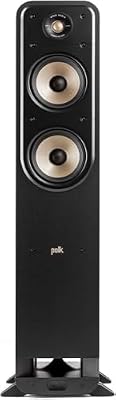
Polk Signature Elite ES55 Tower Speaker – Hi-Res Audio Certified, Dolby Atmos & DTS:X Compatible, 1″ Tweeter & (2) 6.5″ Woofers, Polk Power Port Technology for Effortless Bass, Stunning Black
RUNNER-UP
The ES55 suits systems splitting time between movies and music. Two 6.5-inch woofers work with Polk’s Power Port, smoothing airflow for bass with less port noise near walls. It is certified for Hi-Res Audio and lists Dolby Atmos and DTS:X compatibility. At 41.5 inches high, 8.5 inches wide, 12.5 inches deep, and 44 pounds, it suits typical media rooms. Model ES55BLK is a single speaker, so a pair requires two.
Specs
- (2) 6.5-inch woofers with Polk Power Port technology
- 1-inch tweeter; Hi-Res Audio certified
- Dolby Atmos and DTS:X compatible positioning
- Dimensions 41.5″H x 8.5″W x 12.5″D; weight 44 pounds
- Model ES55BLK, Stunning Black finish
- Sold as a single tower speaker
Best for: Mixed movie and music multichannel systems in medium-sized rooms.
Watch out for: The rear port design still needs some breathing room from the wall; placing it flush against drywall will change the bass balance the Power Port is designed to produce.
ASIN: B09BBLRDCB
View on Amazon
Klipsch Reference Next-Generation R-600F Horn-Loaded Floorstanding Speaker for Best-in-Class Home Theater

The R-600F is the efficiency pick, rated at 96 dB sensitivity — highest here — with 38 Hz to 21 kHz response and 100 watts continuous, 400 watts peak handling at 8 ohms. Front channels reach satisfying levels without an amplifier upgrade. Dual 6.5-inch spun-copper TCP woofers use steeper cone angling, and the 1-inch aluminum LTS tweeter sits in an enlarged 90 x 90-degree Tractrix horn. About 40 inches tall, it needs rear port clearance.
Specs
- Dual 6.5-inch spun-copper TCP woofers
- 1-inch aluminum LTS tweeter with 90 x 90-degree Tractrix horn
- Frequency response 38 Hz to 21 kHz
- Sensitivity 96 dB; power handling 100W continuous / 400W peak
- Nominal impedance 8 ohms; crossover frequency 1,440 Hz
- MDF cabinet with rear-firing Tractrix port; single speaker
Best for: Multichannel builds powered by entry-level or mid-range AV receivers.
Watch out for: The listing includes one speaker; a pair is required for front left and right, and the rear port needs clearance from the wall behind it.
ASIN: B09P8X2Z8P
View on Amazon
SVS Prime Tower Sound Revolution Horn, Gloss Piano (1 per)

The SVS Prime Tower uses a 3.5-way design: a 1-inch aluminum dome tweeter and dedicated 4.5-inch polypropylene midrange above dual 6.5-inch polypropylene woofers, each in its own compartment with its own port tuning. Midrange content thus gets a driver not also reproducing bass. Bandwidth is rated 30 Hz to 25 kHz, recommended amplifier power 20 to 250 watts, in a single Piano Gloss speaker.
Specs
- Dual 6.5-inch polypropylene woofers, each in a separate compartment
- 4.5-inch polypropylene midrange driver; 1-inch aluminum dome tweeter
- 3.5-way design with SoundMatch crossover
- Rated bandwidth 30 Hz to 25 kHz
- Recommended amplifier power 20 to 250 watts; maximum output power 250 watts
- Sold as a single speaker (1 per), Piano Gloss finish
Best for: Detail-focused listeners building a matched SVS Prime multichannel system.
Watch out for: The piano gloss finish shows dust and fingerprints readily in a theater room, and the 3.5-way design rewards a receiver or amplifier comfortably inside its 20 to 250 watt guidance.
ASIN: B00PASULTC
View on Amazon
Which One Fits Your Situation
A Dedicated Theater Room With a Big Screen
Choose the Klipsch RP-8000F Reference Premiere Floorstanding Speaker – Each (Ebony). Dual 8-inch woofers give front-stage scale large rooms absorb, and the horn keeps dialogue focused. Order two, with rear port room.
A Living Room System for Movies and Music
Choose the Polk Signature Elite ES55 Tower Speaker – Hi-Res Audio Certified, Dolby Atmos & DTS:X Compatible, 1″ Tweeter & (2) 6.5″ Woofers, Polk Power Port Technology for Effortless Bass, Stunning Black. Power Port is forgiving of near-wall placement, and its size fits most consoles.
A First Multichannel Build on a Modest Receiver
Choose the Klipsch Reference Next-Generation R-600F Horn-Loaded Floorstanding Speaker for Best-in-Class Home Theater. Its 96 dB sensitivity lets an entry-level receiver drive the front stage convincingly.
A Music-First System That Also Does Surround
Choose the SVS Prime Tower Sound Revolution Horn, Gloss Piano (1 per). The dedicated midrange and 30 Hz to 25 kHz bandwidth serve music in two-channel and multichannel use.
Common Mistakes
- Ordering one tower and expecting a pair; listings here are single speakers.
- Pairing front towers with a center channel from another family, breaking tonal match.
- Pushing rear-ported towers flush against the wall, choking port output.
- Ignoring sensitivity with a modest receiver, whose power supply is shared across channels; efficient fronts like the 96 dB R-600F protect headroom.
- Setting towers as full-range and skipping the subwoofer crossover.
Safety Notes
Speakers are tall, heavy cabinets — the ES55 weighs 44 pounds — so place them on level flooring, out of walkways. Dress cables along walls or under covers so nobody trips and pulls a tower over. Stay within stated power handling; distortion signals to turn down, as sustained clipping can damage tweeters. Unplug the receiver before changing wiring.
Frequently Asked Questions
Do dual-woofer towers replace a subwoofer in a multichannel system?
No. Even the SVS Prime Tower, rated to 30 Hz, cannot substitute for a dedicated subwoofer handling the low-frequency effects channel. Dual woofers give front channels headroom and a smooth crossover blend, while the sub handles effects and the lowest octaves.
How many of these speakers do I need to order?
Two, for front left and right. The RP-8000F is listed as Each, the SVS as 1 per, and the Polk and R-600F are also single-speaker listings. Add a center channel from the same family for a full front stage.
Will my AV receiver drive these speakers?
Check impedance and sensitivity. These speakers suit typical 8-ohm impedance figures, and the R-600F’s 96 dB sensitivity is easiest for modest receivers. SVS guidance is 20 to 250 watts. Use your receiver’s all-channels-driven power figure for planning.
Where should front towers sit in a multichannel layout?
Flank the screen, angled toward the main seat, tweeters near seated ear height, with space behind cabinets for rear ports. Keep each tower’s distance to the listening position as equal as possible, then let receiver calibration set levels and delays.
Related Reviews & Guides




Best Laminator Machines for Home, School, and Office

Best Professional Grade Tensems Combination Therapy Systems